 FigureCheck
Accuracy vs precision: random and systematic error explained
Learn the difference between accuracy and precision, identify random and systematic error, and decide how each affects a scientific graph.
Accuracy describes closeness to an accepted value; precision describes how closely repeated measurements agree. Random error mainly increases spread, while systematic error shifts measurements in a consistent direction.
Four ideas that should not be mixed up
A measurement can be precise but inaccurate when repeated values cluster tightly around the wrong value. It can be accurate on average but imprecise when repeated values are widely scattered. Random variation is visible in repeated measurements; a calibration offset, zero error, or consistently flawed method can create systematic error.
What a graph can and cannot reveal
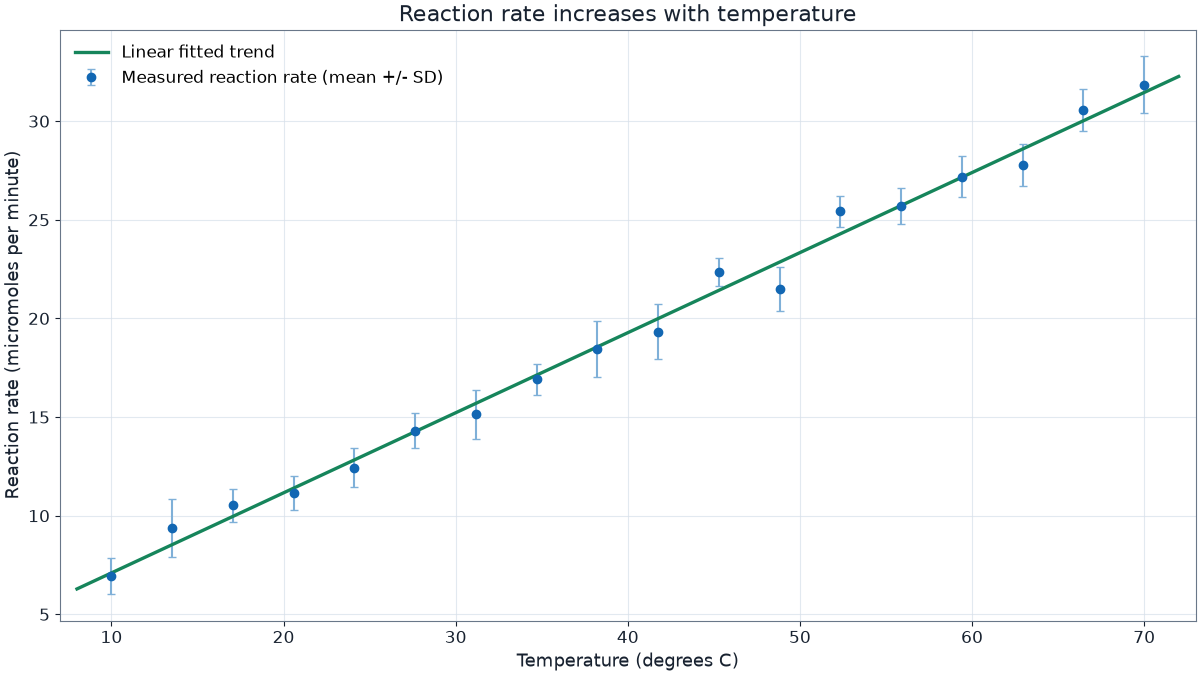
Scatter and error bars can show variability and precision. They cannot prove accuracy unless the measurements are compared with a reliable reference. Repeating a measurement helps characterize random variation, but repetition alone does not remove a systematic bias.
Worked example: a miscalibrated balance
A balance reports 10.42 g, 10.41 g, and 10.42 g for a 10.00 g reference mass. The readings are precise because they agree closely, but inaccurate because they are all high by about 0.42 g. The narrow spread is random uncertainty; the offset suggests systematic error.
Common mistakes to avoid
- Calling every difference a human error
- Using more repeats as a cure for calibration bias
- Treating a small standard deviation as proof of accuracy
Open an editable example and apply the idea to a real graph.
Sources and further reading
These links support the scientific principles summarized above. Always follow the reporting rules required by your course, laboratory, journal, or field.