 FigureCheck
Choosing a statistical test
Welch t-test vs Mann-Whitney U test
Choose an independent-group comparison by matching the scientific question and sampling design, then report effect size alongside the p-value.
Hands-on example
Try this in FigureCheck
Compare Control and Treatment with Welch and Mann-Whitney results, then read both effect sizes.
Opens a small synthetic dataset with a step-by-step guide in a new editable session.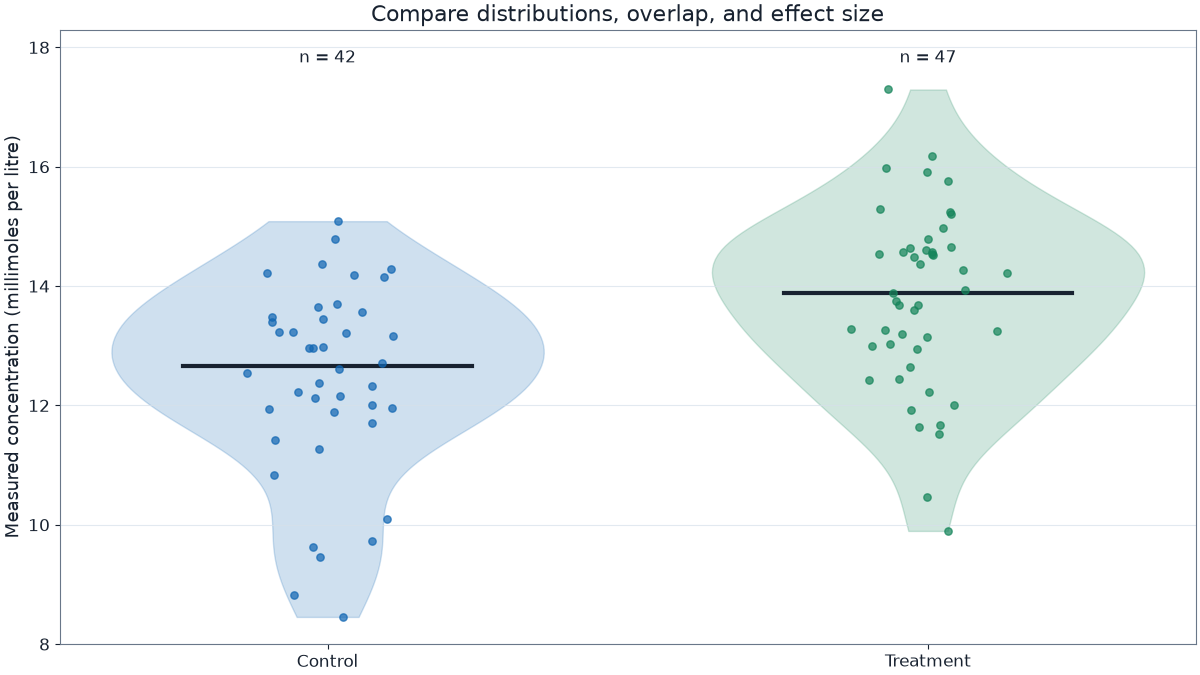
Welch's t-test compares means
Welch's independent t-test asks whether two population means differ under independent sampling. It does not require equal group variances and is generally preferable to the equal-variance Student t-test when that equality is not established. Strong skew, tiny samples, or influential outliers can still make a mean comparison unstable.
Mann-Whitney compares ranks
The Mann-Whitney U test asks whether observations from one group tend to rank higher than observations from the other. It is not automatically a test of medians; a median interpretation needs compatible distribution shapes. Tied values and the sampling design also matter.
Use several pieces of evidence
- Plot both distributions and report group sizes.
- Use Welch when the scientific question concerns average values.
- Use Mann-Whitney when an ordered rank comparison is meaningful.
- Report Hedges' g or a rank effect size, not only statistical significance.
- Do not use a paired test unless observations were intentionally matched.
FigureCheck runs complementary tests for two selected visible series. See the broader independent-group comparison guide for KS tests, multiple evidence, and limitations.